
Summary: Choosing between React and Next.js can define the growth trajectory of SaaS Startups. This guide breaks down performance, SEO, scalability, cost, and real-world use cases to help founders and tech leaders choose the right frontend framework for long-term success.
Every successful digital product begins with one core decision: choosing the right technology foundation. For SaaS Startups, this decision can define product speed, user experience, search visibility, scalability, and even investor confidence. A slow interface, poor SEO, or performance bottleneck can silently kill user adoption before growth even begins. This is where the debate of React vs Next.js becomes critical.
Both frameworks are powerful, widely adopted, and trusted by global tech brands. But they serve different goals, especially when it comes to building scalable SaaS platforms. This guide breaks down the real-world impact of both technologies—so founders, product managers, and CTOs can confidently choose what’s right for long-term growth.
Why Frontend Choice Matters for SaaS Growth
Users today expect:
- Instant loading screens
- Seamless navigation
- Mobile responsiveness
- Secure, stable performance
- Clean, intuitive design
For SaaS Startups, these expectations are not “nice to have”—they are business-critical. Your frontend directly influences:
- User onboarding success
- Trial-to-paid conversion
- Product stickiness
- SEO rankings
- Brand credibility
A poor framework choice often leads to technical debt, slow releases, and costly rebuilds.
Understanding React: The UI Powerhouse
React is a JavaScript library developed by Meta. It focuses on building rich, interactive user interfaces using reusable components.
Why React Became Popular Among Startups
- Component-based architecture for rapid development
- Huge ecosystem and developer community
- Powerful state management
- Ideal for dynamic dashboards and user interfaces
- Works with multiple backend stacks
For early-stage SaaS products focused on feature speed and UI flexibility, React often feels like the safest and fastest choice.
Where React Shines for SaaS Startups
- Real-time dashboards
- Admin panels
- Analytics-heavy platforms
- Product MVPs
- Interactive data tools
However, React alone doesn’t offer built-in SEO optimization or server-side rendering without additional setup.
Understanding Next.js: The SaaS Growth Framework
Next.js is a full React-based framework developed by Vercel. It extends React with powerful built-in features designed for performance, SEO, and scalability.
Key Advantages of Next.js
- Server-side rendering (SSR)
- Static site generation (SSG)
- Built-in routing
- API routes
- Faster page loading
- Enterprise-grade performance
For SaaS Startups focused on organic traffic, marketing scalability, and global speed, Next.js has become the preferred frontend foundation.
React vs Next.js: Core Technical Differences
Here’s a clear business-focused comparison of React vs Next.js:
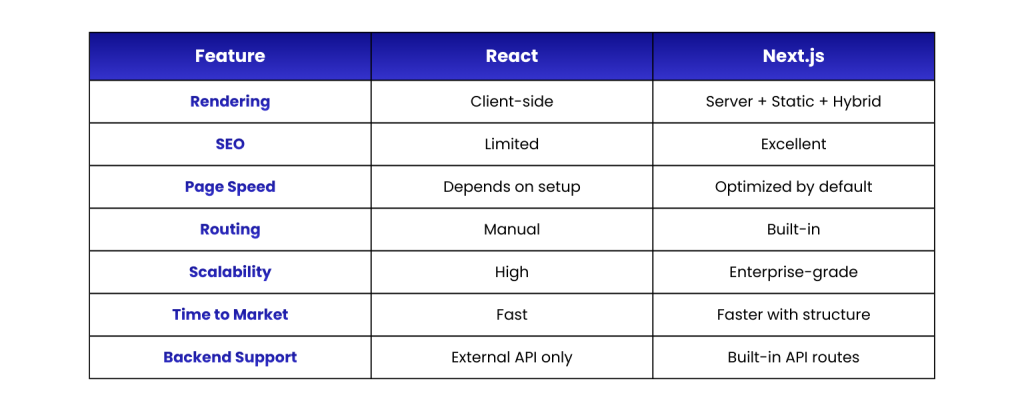
The takeaway: React gives flexibility; Next.js gives structure + speed.
SEO Impact: A Deciding Factor for SaaS Startups
Organic traffic is one of the lowest-cost acquisition channels for SaaS Startups. However, search engines struggle to index JavaScript-heavy pages built with pure React.
Next.js solves this problem using:
- Server-side rendering
- Pre-rendered static pages
- Faster indexation
- Improved Core Web Vitals
If marketing, inbound leads, and long-term content growth are part of your go-to-market plan, Next.js becomes the strategic choice.
This SEO advantage alone makes React vs Next.js a business decision not just a developer preference.
Performance & Speed: User Experience Wins Subscriptions
Every second of page delay reduces conversions. Speed directly impacts:
- Free trial sign-ups
- Product exploration
- Demos and onboarding
- User retention
Next.js automatically optimizes:
- Code splitting
- Image loading
- Caching
- CDN deployment
React performance depends heavily on how well the app is architected and optimized manually.
For SaaS Startups aiming for global users and mobile-first experiences, Next.js delivers reliable performance without heavy engineering effort.
Scalability: Growing Without Rebuilding
Early success creates pressure more users, more data, more traffic, and more features.
React scales well for UI complexity. But Next.js scales better for:
- High-traffic SaaS platforms
- Marketing-heavy SaaS products
- Content + app hybrid models
- International SaaS audiences
This makes Next.js ideal when SaaS Startups are planning beyond MVP and preparing for funding rounds, acquisitions, or enterprise onboarding.
Development Speed & Team Efficiency
Time-to-market decides survival.
React offers:
- Rapid UI experimentation
- Flexible architecture
- Easy integration with any backend
Next.js offers:
- Faster project structure
- Built-in routing and APIs
- Less third-party dependency
- Fewer architectural decisions
In practical terms, Next.js often ships faster than raw React for production-ready SaaS platforms.
Security & Stability in SaaS Platforms
Security is non-negotiable for:
- FinTech SaaS
- HealthTech tools
- Enterprise management systems
- Data-driven products
Next.js offers:
- Controlled server-side execution
- Secure API handling
- Reduced client exposure for sensitive logic
For regulated SaaS Startups, this alone can influence investor trust and compliance readiness.
React vs Next.js for Different SaaS Use Cases
Use React When:
- You’re building an internal dashboard
- Your product is application-only (no need for SEO)
- You want maximum frontend freedom
- You already have a strong backend architecture
Use Next.js When:
- You depend on organic traffic
- You’re building a public-facing SaaS platform
- Performance & SEO are critical
- You plan to scale globally
- You want marketing + product on the same platform
This real-world clarity helps founders make confident technical decisions.
Cost Implications for SaaS Startups
Both frameworks are open-source. The real “cost” comes from:
- Development hours
- Long-term maintenance
- Performance optimization
- SEO improvements
- Infrastructure scaling
React may appear cheaper initially. But Next.js often reduces:
- SEO plugin costs
- Performance optimization costs
- Server architecture complexity
- Future rework
For SaaS Startups with long-term growth plans, Next.js becomes the more cost-efficient option over time.
Investor & Enterprise Perception
Modern investors and enterprise clients increasingly evaluate:
- Tech stack maturity
- Architecture readiness
- Performance benchmarks
- SEO strength
- Security posture
A Next.js-powered SaaS platform often signals:
- Technical scalability
- Marketing-readiness
- Long-term vision
This subtle perception plays a role during funding rounds and B2B enterprise onboarding.
Which Framework Wins for SaaS Startups?
The React vs Next.js debate doesn’t have a single universal winner but there is a strategic winner for most high-growth SaaS products.
- Choose React if your SaaS is:
- Internal-use focused
- Data-heavy with minimal public pages
- Controlled access only
- Internal-use focused
- Choose Next.js if your SaaS is:
- Public-facing
- Marketing-driven
- SEO-dependent
- Built for scale
- Targeting global users
- Public-facing
For most modern SaaS Startups, Next.js is the smarter long-term choice, while React remains a powerful tool for specialized frontend applications.
The Framework You Choose Shapes the Company You Build
Technology is not just code it’s strategy. The right frontend framework influences:
- How fast you grow
- How well you convert users
- How confidently you scale
- How strong your brand performs in search
- How stable your architecture remains under pressure
For SaaS Startups, the decision between React and Next.js is not about trends it’s about building a product that survives competition and grows with confidence.
Looking to build or scale a SaaS product with the right frontend foundation?
A growth-focused technology strategy ensures your SaaS platform is not just built but built to perform, rank, and scale for years to come.
Ready to Build a High-Performance SaaS Platform?
Whether you’re launching your MVP or scaling your SaaS product for thousands of users, choosing the right frontend framework is just the beginning. A future-ready SaaS platform demands speed, SEO, security, and scalability engineered from day one.
Let’s build your SaaS platform for real growth. Talk to our development experts today and turn your idea into a scalable product.