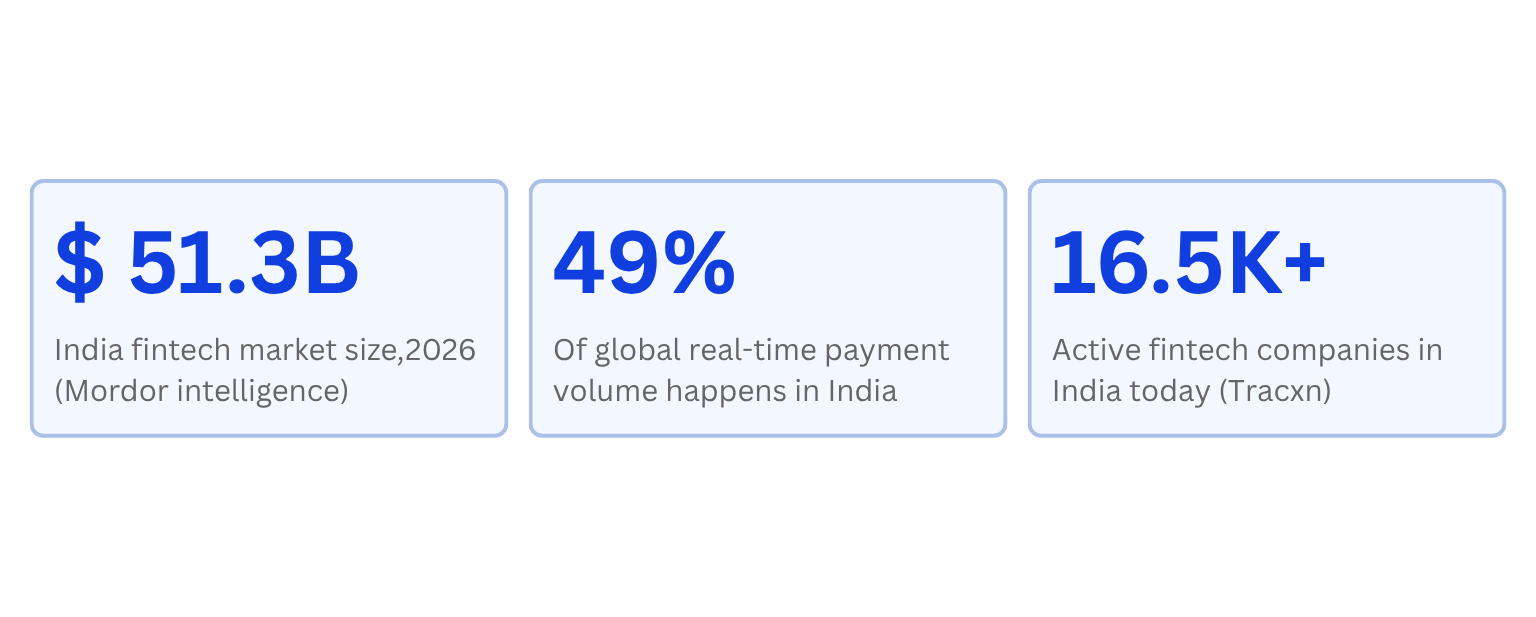
India’s fintech market is on track to cross USD 51 billion in 2026, growing at a 16%+ CAGR and yet, ask any founder who has tried to ship a fintech product here, and they’ll tell you the same thing: building is the easy part. Surviving the launch is what kills you.
RBI directives change every quarter. KYC flows break under load. A single PCI-DSS gap can void your payment partner agreement. And the user sitting in Tier-2 India on a 4G connection with a budget smartphone has zero patience for a 6-second screen load.
This guide is for founders, product leaders, and CTOs who are tired of generic “top 10 fintech development company in India” listicles and want to understand what it actually takes to succeed with professional fintech software development to build a platform that ships, scales, and stays compliant. No fluff. No buzzwords without backing.
Let’s get into it.
Why Fintech in India Is Uniquely Hard (And Why That’s an Opportunity)

Most articles will tell you “the Indian fintech market is booming.” True but unhelpful. What founders actually need to understand is why building here is structurally different from building a fintech product in the US, EU, or Southeast Asia.
1. Regulation is a moving target
The Reserve Bank of India (RBI) introduced its Digital Lending Directions, layered new KYC norms on top of existing PMLA rules, and now governs everything from payment aggregators to account aggregators to neobanking partnerships. If your engineering team isn’t translating regulation into architecture through structured fintech software development, you’re already behind.
2. The scale is unforgiving
India processes nearly half of the world’s real-time payments. A “100k transactions a day” product in the US is a healthy startup. In India, that’s a Tuesday afternoon. Your systems need to be built for spiky, high-throughput, low-margin workloads from day one. Choosing high-quality fintech app development services ensures your app doesn’t crash when traffic peaks.
3. UX expectations are paradoxical
Users want banking-grade trust with consumer-grade speed. They’ll abandon your app if onboarding takes 90 seconds but they’ll also call your support line at midnight if their balance “looks wrong.” There’s no room for ugly compliance flows or beautiful-but-fragile UX.
4. Fraud risk is non-trivial
UPI-related fraud cases are rising every quarter. AI-driven fraud detection isn’t a “nice-to-have feature” anymore it’s table stakes. And it has to work in real time, at sub-100ms latencies, without spiking your cloud bill.
“Launching a fintech product in India is no longer just a technology challenge it is a regulatory engineering problem.”
The 7-Layer Playbook for Building a Fintech Platform in India
After working across BFSI builds including lending platforms, WealthTech dashboards, payment integrations, and InsurTech onboarding flows we’ve found that every successful fintech product gets seven things right. Miss one, and the entire stack wobbles.
01. RBI-Ready Architecture, Not Bolt-On Compliance
Build modular, API-first systems where KYC, AML, audit logging, data localization, and consent management are core services not afterthoughts. If your compliance lives outside your product flow, you’ll re-architect within 18 months. Ensuring you build an RBI compliant fintech app from day one saves millions in future code rewrites.
02. Identity & KYC That Actually Converts
Aadhaar e-KYC, PAN verification, video KYC, liveness checks all need to feel like one smooth flow, not five disconnected screens. Best-in-class platforms convert onboarding above 75%. Most fintech apps in India struggle below 40% due to poor integration.
03. Mobile-First, Performance-First UX
67% of fintech engagement in India happens on mobile. Your app must load on a ₹8,000 Android device on a flaky 4G signal. Investing in scalable banking app development means prioritizing lazy loading, aggressive caching, sub-2-second cold starts, and offline-tolerant flows none of which come for free.
04. AI/ML for Fraud, Risk & Personalization
Real-time fraud scoring, transaction anomaly detection, credit underwriting models, and personalized financial nudges. The platforms winning right now treat ML not as a
feature, but as an internal infrastructure layer that every product surface taps into.
05. QA That Mirrors Production Chaos
Functional testing isn’t enough. Secure fintech software development demands dedicated security testing (OWASP, PCI-DSS), load testing at 10x peak, chaos engineering for partner API failures, and regression suites that cover regulatory edge cases. A bug in fintech isn’t a bug it’s a refund, a fine, or a churned customer.
06. DevOps Built for Audits
Every deploy must be traceable. Every secret rotated. Every log retained for the duration regulators require. CI/CD pipelines that ship 10x a day are great but only if they don’t ship you into a compliance violation. Infrastructure-as-code, immutable deployments, and SOC2-aligned ops are the baseline.
07. Web + Mobile + Admin, as One Product
Customer mobile app, partner web portal, internal admin dashboard, support tools all running on the same data model with role-aware UX. Treat them as one product, not three. Otherwise, every regulatory change becomes three release cycles instead of one.
Where Most Fintech Builds Go Wrong

If you’ve spoken to founders whose fintech apps stalled, you’ve probably heard the same four stories. Here’s how to avoid them during fintech software development.
- Pitfall 1: Building on legacy “core banking” plumbing. Banking and NBFC partners often hand you decades-old core systems with batch processing, brittle APIs, and 2 AM downtime windows. If your product layer doesn’t abstract and buffer these legacy systems behind clean modern APIs, the legacy becomes your bottleneck and your reputation.
- Pitfall 2: Treating compliance as a launch checklist. Compliance isn’t a phase. It’s a property of the product. Teams that try to “add KYC” or “wire up audit logs” three weeks before launch end up rebuilding 40% of their stack. Bake it in from sprint one or pay the rebuild tax later.
- Pitfall 3: Underestimating UX in a regulated flow. Mandatory disclosures, consent screens, and key fact statements (KFS) have to appear but they don’t have to feel like a wall of legal text. Great fintech UX hides complexity behind progressive disclosure, plain-language summaries, and contextual help. Done well, users still convert. Done poorly, you’ll lose 30% of them at the consent screen alone.
- Pitfall 4: Ignoring fraud until it’s too late. Most fintech founders treat fraud detection as a “v2 feature.” By the time v2 ships, you’ve absorbed losses, generated negative reviews, and lost goodwill with your partner bank. Ship with at least baseline rules-based fraud detection anomaly detection on velocity, geography, device, and behavior. Layer ML on top once you have data.
Build vs. Buy vs. Partner: How to Decide
One of the most expensive decisions in any fintech build is: which pieces do we build, which do we buy, which do we partner for? A rough heuristic that’s worked well across the projects we’ve shipped:
Build the things that are your product differentiator your underwriting model, your unique UX, your data layer. If a vendor can replicate it, it’s not your moat.
Buy / integrate commodity services: KYC providers (HyperVerge, IDfy), payment rails (Razorpay, Cashfree), e-sign (Digio, Leegality), and infrastructure (AWS / Azure with India-region data residency). Don’t reinvent.
Partner for licensed activities co-lending with an NBFC, banking-as-a-service with a partner bank, custody with a SEBI-registered entity. You don’t need to chase a license you can rent for the first 18 months.
`
How We Build for BFSI & Fintech
This is the part where most agency blogs turn into a brochure. We’ll keep it short and concrete.
Diginnovators provides end-to-end fintech app development services and has shipped fintech and BFSI products across lending, WealthTech, payments, InsurTech, and NBFC platforms. The stack we typically lean on for high-performance fintech software development:
- Web & Backend: Node.js, Python (Django / FastAPI), Java Spring for compliance-heavy services, microservices on Kubernetes
- Mobile: React Native and Flutter for cross-platform speed, native Swift / Kotlin where performance demands it
- AI/ML: Python ML stacks, vector databases for personalization, real-time fraud scoring via streaming pipelines
- QA: Functional + security + load + chaos testing as standard, not optional
- DevOps: CI/CD on GitHub Actions / GitLab, infrastructure-as-code with Terraform, observability via Datadog / Grafana, audit-grade logging by default But the stack isn’t the differentiator process. Every fintech engagement we take on starts with a compliance & risk discovery sprint before a single line of code is written. That’s how we keep clients from doing the “rebuild within 18 months” dance.
Looking to build a compliant fintech platform development project that scales seamlessly? [Get in touch with Diginnovators today] to set up your compliance and technical discovery sprint.
Frequently Asked Questions