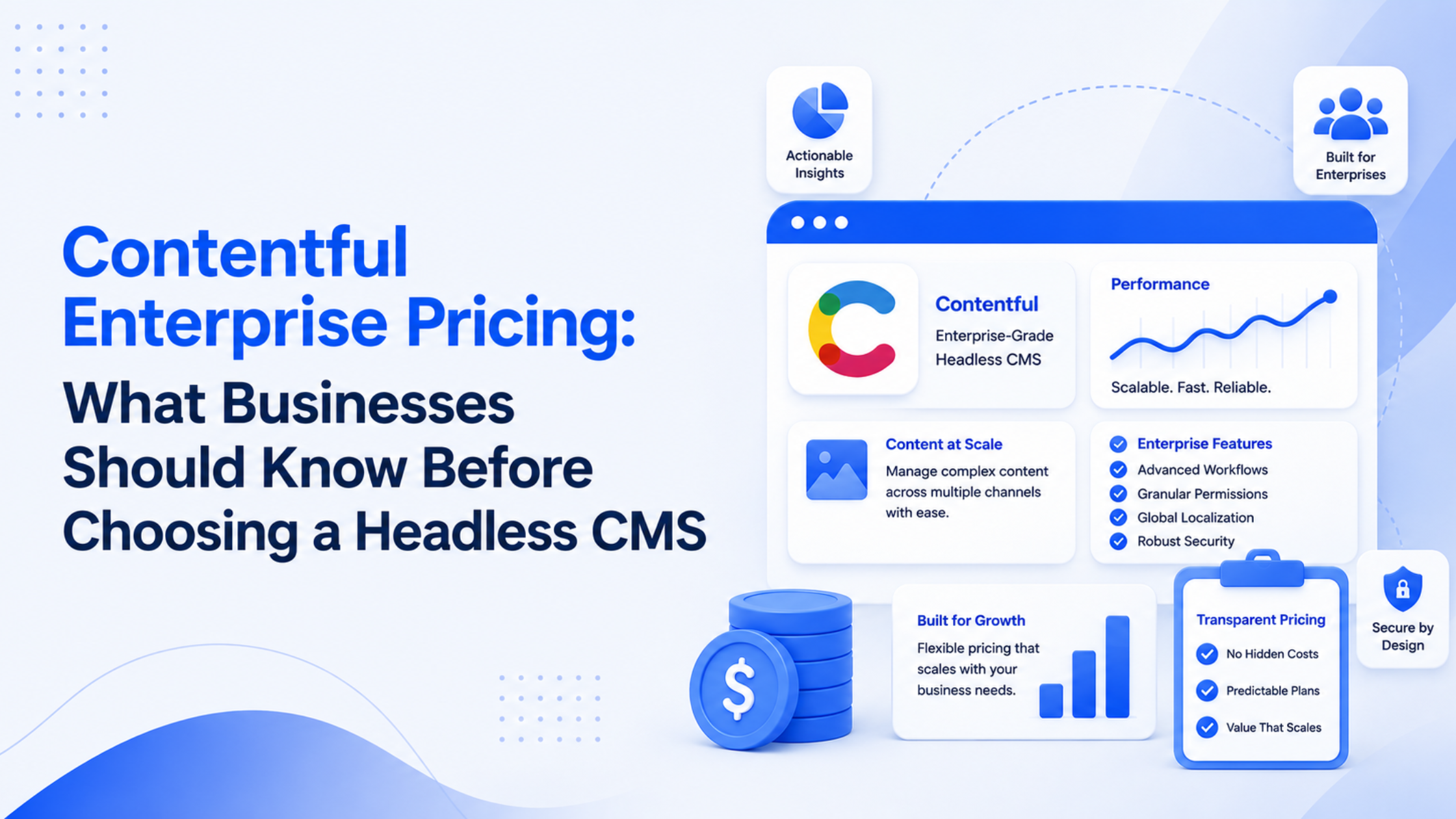
Why is this question so hard to answer? If you’ve tried to find a straight answer on Contentful Enterprise Pricing, you’ve probably hit a wall. There’s a “Contact Sales” button where a price should be, and a dozen third-party sites throwing out wildly different numbers.
That’s not an accident. At the top tier, Contentful like most enterprise software doesn’t publish a fixed price. It builds a custom quote around your usage and needs. That makes sense for them, but it leaves you guessing.
So instead of pretending there’s one magic number, let’s do something more useful: explain exactly how the pricing works, what pushes it up or down, and how to walk into that sales call prepared.
First, what is Contentful?
Quick refresher, because it matters for the price. Contentful is a headless CMS a system that stores your content separately from how it’s displayed, then delivers it anywhere through an API.
A traditional CMS (like a standard WordPress setup) bundles content and presentation together. An API-first CMS decouples them, so the same content can flow to a website, a mobile app, a smartwatch, or a kiosk. That flexibility is why the Contentful CMS is often described not just as a CMS but as a digital experience platform infrastructure for delivering content across every channel a brand touches.
That positioning is the key to understanding Contentful Enterprise Pricing: you’re not paying for a website tool, you’re paying for content infrastructure.
How Contentful Enterprise Pricing actually works

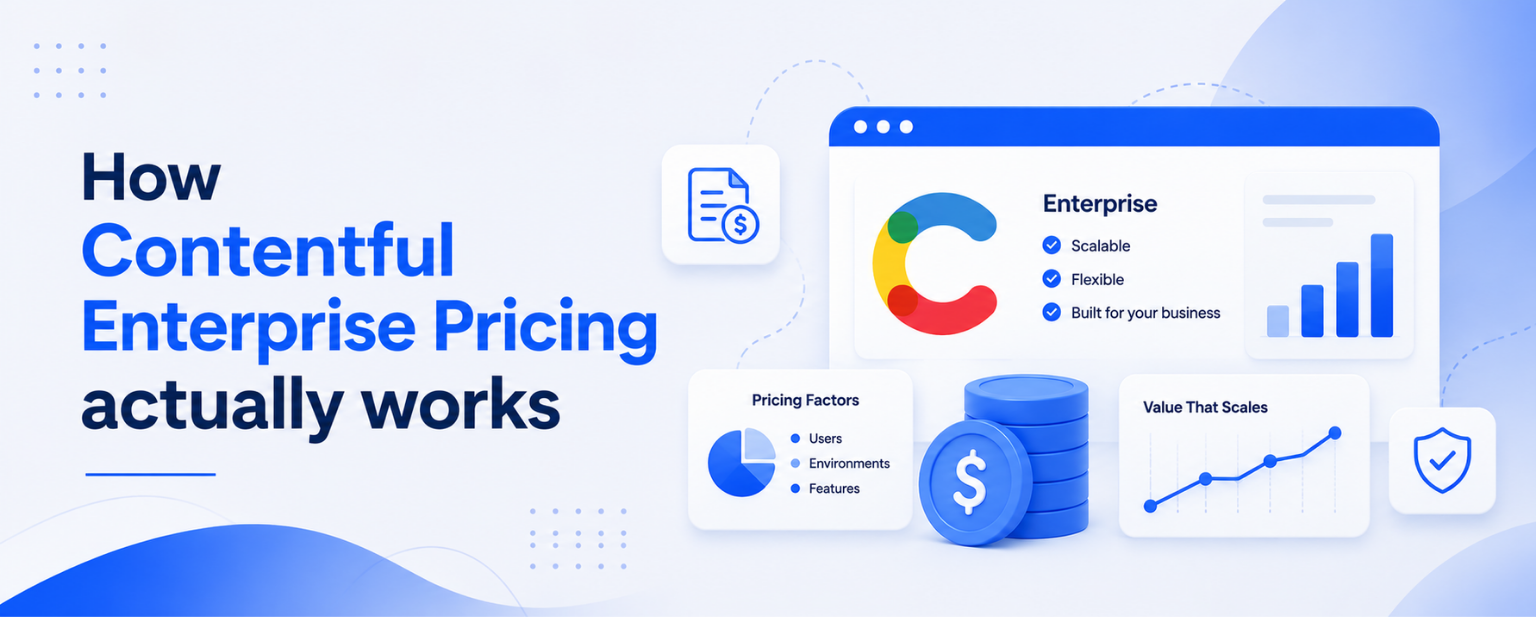
Contentful uses a tiered model with usage-based charges layered on top. Broadly, there are three levels:
- Free — $0, genuinely useful for small projects, side builds, and testing. Limited users, records, and API calls.
- A paid mid-tier — a published monthly price aimed at small teams and single projects.
- Premium / Enterprise — fully custom, quoted by their sales team.
At the enterprise level, the price is built from a base platform fee plus usage. The more you use, the more you pay. That’s the heart of Contentful Enterprise Pricing, and it’s why two companies can get quotes that look nothing alike.
Reality check: Contentful doesn’t publish enterprise numbers, and third-party figures range from a few thousand to well into six figures a year. Treat any specific price you see online as a rough rumour, not a quote. Your real number depends on the drivers below.
What actually drives the cost up
Here’s where the money goes in an enterprise CMS agreement. Understanding these gives you leverage:
- API calls. Every time your site or app requests content, that’s an API call. High-traffic sites burn through them fast, and overages add up.
- Content records (entries and assets). More content = a higher tier. Large catalogues and media libraries push you up.
- Users and roles. Enterprise plans price in seats. Big content teams cost more, especially with granular role-based permissions.
- Spaces and environments. Separate environments for development, staging, and production — and multiple brand “spaces” — all factor in.
- Locales (languages). Every language you localise into adds weight. Global brands feel this quickly.
- Premium features. Single sign-on (SSO), advanced security, guaranteed uptime SLAs, and priority support are typically what separate the enterprise tier from the mid-tier — and they carry a premium.
Contentful Enterprise Pricing scales with your ambition. A modest site stays affordable; a global, multi-brand, multi-language operation is a serious investment.
The hidden costs people forget
The subscription is only part of the picture. Budget for these too:
- Implementation and development. A headless setup needs a front end built and connected. That’s developer time often the biggest first-year cost.
- Migration. Moving existing content into the platform takes planning and hands.
- Overages. Blow past your API-call or record limits and the bill climbs mid-contract.
- Ongoing upkeep. Someone has to maintain the integrations as your stack evolves.
None of this makes Contentful a bad choice it just means the sticker price isn’t the whole story for any platform like this.
Is Contentful Enterprise Pricing worth it?
It depends entirely on what you’re building. Be honest about which camp you’re in.
It’s often worth it when you: deliver content to many channels (web, apps, devices), operate across several languages or brands, have a developer team to build front ends, and need enterprise-grade security and support. For those teams, a true digital experience platform earns its keep.
It’s probably overkill when you run a fairly standard website, have a small or non-technical team, and mainly need pages, a blog, and simple updates. In that case a traditional CMS delivers most of the value at a fraction of the cost and complexity.
There’s no prize for buying the most powerful content management platform. The prize is fit.
A 60-second checklist before you talk to sales
Walk in with answers to these, and you’ll get a sharper quote and avoid overpaying:
- [ ] How many API calls will our traffic realistically generate?
- [ ] How many content records and assets do we have today, and in two years?
- [ ] How many editors and admins need access?
- [ ] How many languages and brand spaces?
- [ ] Do we truly need SSO, advanced security, and an uptime SLA?
- [ ] Who is building and maintaining the front end?
- [ ] What happens to the price if we exceed our limits?
Every answer you bring is a number they can’t pad.
How to keep the cost under control
A custom quote does not mean you are powerless. A few habits keep the number sensible. Right-size your plan to real usage rather than a worst-case guess, and revisit it as you grow instead of over-buying on day one. Cache aggressively so you are not paying for API calls you do not need. Archive or clean up stale content records so your library reflects what you actually use. Consolidate spaces and environments where it makes sense, and only pay for the languages you truly publish. Finally, negotiate: enterprise deals almost always have room, especially on multi-year terms, so ask what can flex. Treating usage as something you manage not just accept is the difference between a bill that creeps up every year and one that stays predictable.
Conclusion
Contentful Enterprise Pricing isn’t hidden to be sneaky it’s custom because the platform scales to fit very different businesses. The smart move isn’t hunting for a magic figure online; it’s understanding the drivers, budgeting for the hidden costs, and being ruthlessly honest about whether this kind of platform matches how you actually work.
Get that right and you’ll either land a quote that’s fair for real enterprise needs or realise a simpler setup will serve you better for far less. Either way, you win.
Weighing up your CMS options? Let’s talk we’ll help you compare the options honestly and pick the platform that fits your goals and budget.
Frequently Asked Questions