Software companies frequently manage documentation, product updates, feature announcements, and knowledge bases.
Prismic’s structured content model makes it easier to organize and publish this information while maintaining consistency across multiple products.
E-commerce Experiences
Although Prismic isn’t an e-commerce platform itself, it integrates well with modern commerce solutions.
Businesses can use it to manage:
- Product storytelling
- Buying guides
- Landing pages
- Promotional campaigns
- Brand content
This creates a richer customer experience while allowing commerce platforms to handle transactions.
Multi-Language Websites
For organizations operating internationally, managing localized content can become challenging.
Prismic supports multilingual content, making it easier to publish region-specific experiences while maintaining a centralized content management process.
Best Practices for Using Prismic
Getting the most from Prismic for Developers isn’t just about choosing the platform it’s also about using it effectively.
Here are some best practices to help development teams build scalable and maintainable projects.
Plan Your Content Model Early
Before writing code, define how content will be structured.
Think about:
- Pages
- ComModern websites have evolved far beyond simple online brochures. Businesses now expect their websites to deliver personalized experiences, integrate with multiple platforms, support various digital channels, and scale as their operations grow. To meet these demands, developers need content management systems that offer flexibility without limiting creativity.
This is where Prismic for Developers has become a popular choice.
Unlike traditional CMS platforms that tightly connect content with website templates, Prismic follows a headless architecture. It separates content management from the presentation layer, giving developers complete freedom to build modern digital experiences using their preferred technologies.
Whether you’re creating a corporate website, an eCommerce platform, a SaaS application, or a multi-language marketing site, Prismic for Developers provides a flexible content infrastructure that supports faster development and easier content management.
In this blog, we’ll explore why developers are increasingly choosing Prismic, its key features, business benefits, and how it supports modern web development without compromising performance or scalability.
What is Prismic?
Before understanding why Prismic for Developers is gaining popularity, it’s important to understand what Prismic actually is.
Prismic is an API-first CMS that allows developers and content teams to work independently while staying connected through structured content.
Unlike traditional content management systems that combine content, templates, and design into one platform, Prismic stores content separately and delivers it through APIs.
This means the same content can be published across multiple digital channels, including:
- Business websites
- Mobile applications
- Customer portals
- E-commerce platforms
- Digital kiosks
- Progressive Web Apps (PWAs)
By separating content from presentation, developers gain complete control over how digital experiences are designed and delivered.
Why More Developers Are Choosing Prismic
Modern development teams want tools that help them move faster without sacrificing quality.
Prismic for Developers offers a balance between developer flexibility and editor-friendly content management, making it attractive for both technical and non-technical teams.
Here are some of the main reasons developers are adopting Prismic.
Complete Frontend Freedom
One of the biggest advantages of Prismic for Developers is the freedom to build with virtually any frontend technology.
Instead of being restricted by themes or predefined templates, developers can create custom experiences using frameworks such as:
- Next.js
- React
- Vue.js
- Nuxt
- SvelteKit
- Angular
This flexibility enables teams to build websites that match their exact business requirements while maintaining complete control over performance and design.
Content Editors Can Work Independently
In many development projects, marketing teams depend on developers for even small content updates.
Prismic removes this dependency.
Content editors can:
- Update website copy
- Publish blogs
- Edit landing pages
- Manage product information
- Schedule content
all without modifying the frontend code.
This separation improves collaboration between developers, marketers, and content teams while reducing development bottlenecks.
Built for Modern Web Development
Today’s websites are expected to deliver exceptional performance across every device.
Modern users expect:
- Fast loading pages
- Mobile responsiveness
- Seamless navigation
- Personalized experiences
- Reliable performance
Prismic for Developers supports these expectations by fitting naturally into modern development workflows.
Because it functions as a Headless CMS, developers can optimize every aspect of the frontend independently while using Prismic solely for content management.
This architecture provides greater flexibility when building:
- Corporate websites
- Marketing websites
- SaaS platforms
- E-commerce stores
- Enterprise portals
- Multi-brand websites
Why Businesses Also Benefit
Although Prismic is designed with developers in mind, businesses also gain significant advantages.
When developers spend less time managing content changes, they can focus on building better features and improving website performance.
Meanwhile, marketing teams gain the ability to publish and update content independently, reducing turnaround times for campaigns and website updates.
This balance between developer control and editorial flexibility is one of the reasons Prismic for Developers continues to gain adoption among modern web teams.
Core Features That Make Prismic Stand Out
The growing popularity of Prismic for Developers isn’t just because it’s a headless CMS—it’s because it simplifies everyday development while giving teams the flexibility to build modern digital experiences. From API-first architecture to reusable components, Prismic is designed to support faster workflows without limiting creativity.
Let’s explore the features that make it a preferred choice for modern web projects.
API-First Architecture
One of the biggest strengths of Prismic for Developers is its API-first approach.
Unlike traditional content management systems that tightly connect the backend and frontend, Prismic stores content independently and delivers it through APIs. This allows developers to build websites and applications using any frontend framework while keeping content management centralized.
An API-first CMS makes it easier to:
- Deliver content across multiple platforms
- Integrate with third-party services
- Support websites, mobile apps, and digital products
- Scale projects without changing the content structure
For development teams building omnichannel experiences, this flexibility is a major advantage.
Seamless Integration with Modern Frameworks
Modern web development relies on frameworks that prioritize speed, performance, and user experience.
Prismic for Developers integrates smoothly with popular technologies such as:
- Next.js
- React
- Vue.js
- Nuxt
- SvelteKit
- Gatsby
Instead of forcing developers to follow a predefined structure, Prismic adapts to existing workflows, allowing teams to use the tools they’re already comfortable with.
This flexibility shortens development cycles while making projects easier to maintain.
Slice Machine for Reusable Components
Building every webpage from scratch can be time-consuming.
Prismic simplifies this with Slice Machine, a feature that lets developers create reusable page sections that content editors can assemble without writing code.
Common reusable slices include:
- Hero banners
- Feature highlights
- Testimonials
- Pricing tables
- FAQs
- Call-to-action sections
- Image galleries
Once these components are created, editors can mix and match them to build new pages quickly while maintaining design consistency.
For development teams, this means fewer repetitive coding tasks and a more efficient workflow.
Visual Preview for Faster Content Publishing
Content creators often struggle to imagine how their changes will appear before publishing.
Prismic addresses this with live preview capabilities that allow editors to review content changes before they go live.
This feature helps teams:
- Reduce publishing errors
- Review layouts before launch
- Collaborate more effectively
- Publish content with greater confidence
Developers also benefit because fewer content revisions mean fewer last-minute fixes.
Flexible Content Modeling
Every website has unique content requirements.
A company blog, an eCommerce store, and a SaaS platform all organize information differently.
Rather than forcing businesses into rigid templates, Prismic CMS allows developers to build custom content models based on project requirements.
Developers can create structured content for:
- Blog articles
- Product catalogs
- Service pages
- Case studies
- Documentation
- Team profiles
- Customer success stories
This structured approach improves consistency while making future content updates much easier.
Better Collaboration Between Developers and Content Teams
One common challenge in website projects is balancing developer workloads with marketing needs.
Without the right content management system, developers often become responsible for small updates like changing headings, updating images, or publishing landing pages.
Prismic for Developers solves this by giving content editors the tools they need to manage content independently.
Marketing teams can:
- Publish blogs
- Update landing pages
- Edit product information
- Launch campaigns
- Manage SEO content
Meanwhile, developers can focus on building new features, improving website performance, and solving technical challenges.
This separation creates a smoother workflow for everyone involved.
Performance That Supports Modern Websites
Website speed plays an important role in both user experience and search engine visibility.
Because Prismic separates content management from presentation, developers have complete control over frontend optimization.
This makes it easier to build websites that offer:
- Faster page loading
- Better Core Web Vitals
- Improved mobile performance
- Efficient caching
- Optimized content delivery
For businesses investing in modern web development, these performance improvements can contribute to higher engagement and better overall user experiences.
A Scalable Solution for Growing Businesses
As businesses grow, their digital needs often become more complex.
They may expand into new markets, launch additional websites, support multiple languages, or introduce new digital products.
Prismic for Developers is built with scalability in mind.
Whether managing a single website or an enterprise-level digital ecosystem, the platform provides the flexibility to grow without requiring a complete rebuild of the content management system.
Its structured content model and Headless CMS architecture make it easier to adapt as business requirements evolve, helping organizations stay prepared for future growth.
Prismic vs Traditional CMS: What’s the Difference?
Choosing the right content management system is about more than just publishing content. It affects how quickly developers can build, how easily content teams can manage updates, and how well a website performs as business needs grow.
While traditional CMS platforms have been the go-to choice for years, Prismic for Developers offers a more flexible approach that aligns with modern web development practices.
Here’s a quick comparison:
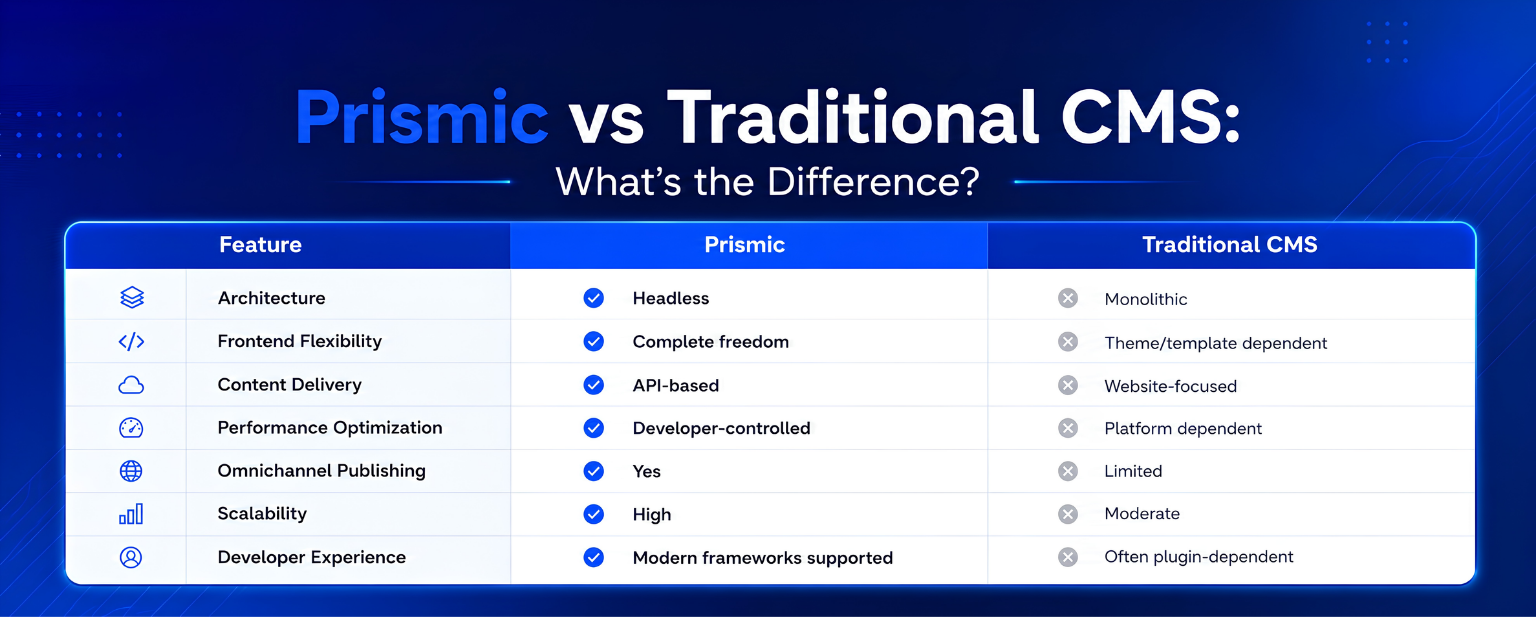
Traditional CMS platforms are still suitable for many projects, but when businesses need flexibility, scalability, and multi-channel content delivery, Prismic for Developers offers a more future-ready solution.
Common Use Cases for Prismic
One reason Prismic for Developers continues to gain popularity is its versatility. It supports projects of different sizes and industries while adapting to various business needs.
Some common use cases include:
Corporate Websites
Businesses can manage company information, services, case studies, blogs, and career pages from one centralized platform while giving developers complete control over the frontend experience.
Marketing Websites
Marketing teams often launch campaigns, landing pages, and promotional content on tight deadlines.
With Prismic CMS, content editors can update pages independently, allowing campaigns to go live faster without relying on developers for every content change.
SaaS Platforms
- ponents
- Categories
- Relationships
- Reusable content
A well-planned content model reduces future development effort.
Build Reusable Components
Avoid creating unique layouts for every page.
Instead, design reusable slices for:
- Hero sections
- Feature blocks
- FAQs
- Testimonials
- Pricing sections
- CTAs
Reusable components improve consistency while reducing development time.
Keep Content and Design Separate
One of the biggest strengths of a Headless CMS is separating content from presentation.
Allow editors to focus on content while developers focus on performance, functionality, and user experience.
This separation creates a smoother workflow and simplifies future updates.
Optimize for Performance
Modern users expect fast websites.
Developers should combine Prismic with performance best practices such as:
- Image optimization
- Lazy loading
- CDN delivery
- Efficient caching
- Core Web Vitals optimization
These improvements contribute to better user experiences and search engine performance.
Review Content Regularly
Content should evolve alongside the business.
Regularly review:
- Outdated pages
- Broken links
- SEO performance
- Content accuracy
- User engagement
Keeping content fresh helps maintain credibility and improve website performance over time.
Why Businesses and Developers Benefit Together
A successful website isn’t built by developers alone.
Marketing teams, content creators, designers, SEO specialists, and business stakeholders all contribute to creating meaningful digital experiences.
Prismic for Developers bridges the gap between technical teams and content editors by allowing each group to focus on what they do best.
Developers gain:
- Greater frontend flexibility
- Faster development workflows
- Easier integrations
- Cleaner architecture
- Better scalability
At the same time, businesses benefit from:
- Faster content publishing
- Improved collaboration
- Consistent branding
- Easier website maintenance
- Greater agility when launching campaigns
This shared efficiency helps organizations deliver better digital experiences while reducing bottlenecks between technical and non-technical teams.
Conclusion
Modern websites demand more than attractive designs they require flexibility, speed, scalability, and efficient content management. That’s why Prismic for Developers has become a preferred choice for teams building modern web projects.
Its Headless CMS architecture allows developers to use their preferred frontend frameworks while giving content teams the freedom to manage and publish content independently. This separation creates faster development workflows, improves collaboration, and makes websites easier to maintain as businesses grow.
Whether you’re launching a marketing website, a SaaS platform, an eCommerce experience, or a multilingual corporate site, Prismic provides the flexibility to support your long-term digital goals. Its API-first approach, reusable components, structured content, and seamless integrations make it well-suited for organizations that want to build scalable, future-ready digital experiences.
Ultimately, choosing the right CMS isn’t just about today’s requirements it’s about preparing for tomorrow’s opportunities. For development teams looking to build high-performing websites with greater flexibility and efficiency, Prismic for Developers offers a modern solution that supports both innovation and growth.
Frequently Asked Questions