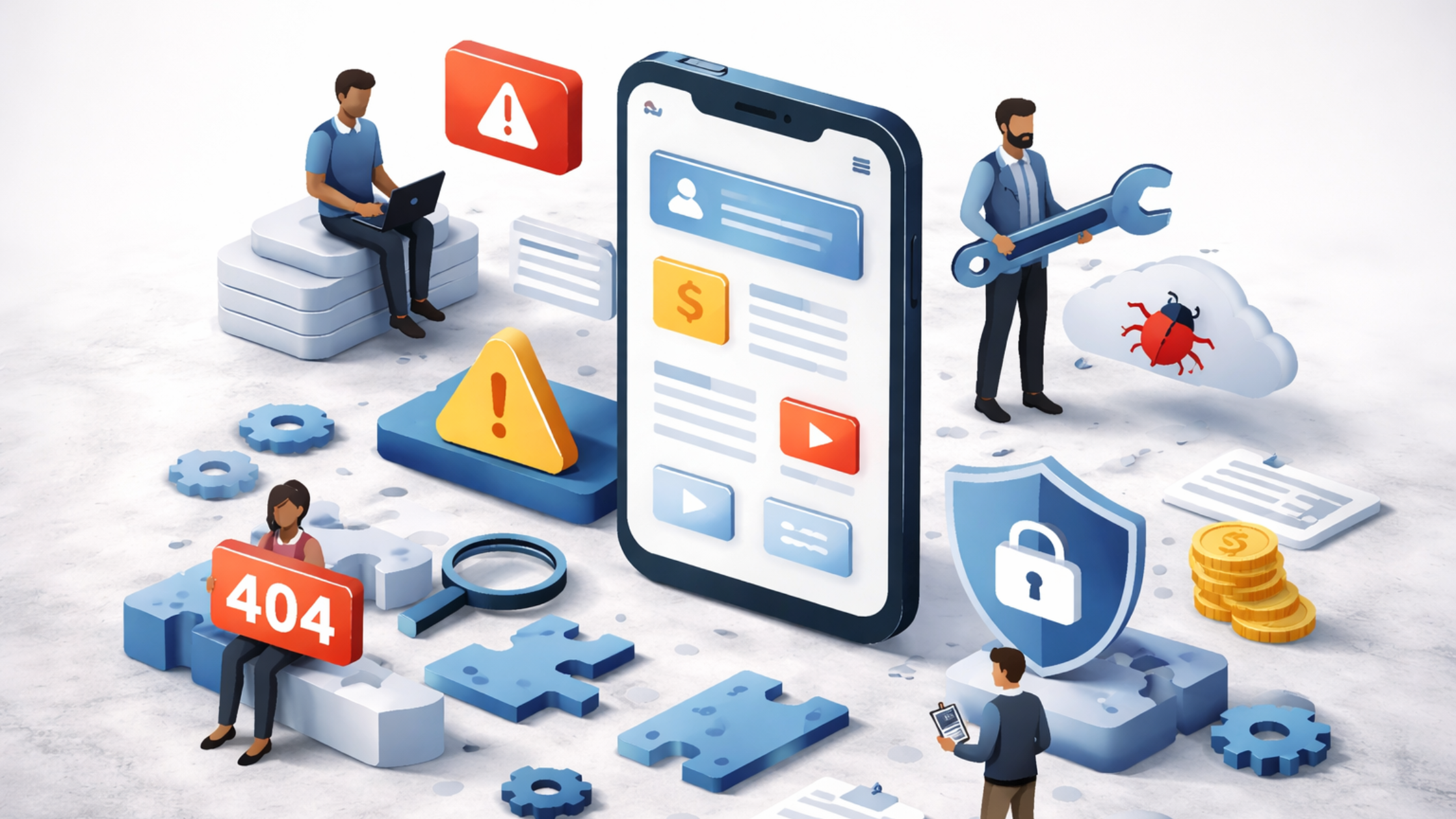
Mobile apps are no longer just an additional business asset. In 2026, they have become one of the most important touchpoints between brands and customers. From startups launching innovative platforms to enterprises improving customer engagement, businesses across industries are investing heavily in mobile applications to stay competitive.
But while the demand for mobile apps continues to rise, many businesses still struggle with one common challenge avoiding critical app development mistakes that impact performance, user retention, scalability, and long-term growth.
A mobile app may look visually appealing at launch, but if it lacks proper planning, poor security, or an optimized user experience, it can quickly lose users and affect business credibility.
Understanding these mistakes early can save businesses significant time, money, and development effort. In this blog, we’ll explore the top 5 mobile app development mistakes businesses should avoid in 2026 and how to build applications that are scalable, user-focused, and future-ready.
1. Ignoring User Experience in Mobile Apps
One of the biggest app development mistakes businesses make is prioritizing features over user experience.
Many companies assume adding more functionalities will automatically make the app better. However, modern users expect apps to be simple, intuitive, fast, and easy to navigate. Even a highly functional app can fail if users struggle to understand how it works.
Common UX Mistakes
- Complex navigation
- Slow loading screens
- Poor button placement
- Inconsistent design
- Too many steps during signup or checkout
- Lack of accessibility optimization
In 2026, users have shorter attention spans and higher expectations than ever before. Research consistently shows that users uninstall apps quickly if the experience feels confusing or frustrating.
How to Avoid This Mistake
Focus on creating a user-first app development process. Conduct proper user research, test prototypes early, and prioritize clean UI/UX design throughout development.
Businesses should:
- Simplify user journeys
- Optimize app speed
- Maintain design consistency
- Ensure accessibility across devices
- Continuously collect user feedback
A strong user experience in mobile apps improves engagement, increases retention, and helps businesses build long-term customer trust.
2. Skipping Proper Planning in the App Development Process
Rushing directly into coding without a clear strategy is another major mistake businesses continue to make.
A successful app requires much more than an idea. Without proper planning, projects often face delays, budget overruns, feature confusion, and scalability issues later.
Why Planning Matters
The app development process should define:
- Business goals
- Target audience
- Feature priorities
- Technology stack
- Development timelines
- Budget expectations
- Security requirements
- Future scalability plans
When businesses skip this stage, development teams often encounter repeated revisions, unclear requirements, and inefficient workflows.
The Impact of Poor Planning
Poor planning can lead to:
- Increased development costs
- Delayed launches
- Technical debt
- Poor app performance
- Inconsistent functionality
In competitive industries, delays alone can cause businesses to lose market opportunities.
How to Avoid This Mistake
Before development begins, businesses should create a detailed roadmap that aligns technical execution with business objectives.
An effective app development process includes:
- Market research
- Competitor analysis
- Wireframing and prototyping
- MVP planning
- Technology selection
- QA testing strategy
- Post-launch maintenance planning
A well-planned development approach reduces risks and ensures smoother execution throughout the project lifecycle.
3. Neglecting Mobile App Security
As cyber threats continue to evolve, mobile app security has become one of the most critical aspects of app development in 2026.
Unfortunately, many businesses still treat security as an afterthought instead of integrating it from the beginning.
This mistake can result in:
- Data breaches
- Financial losses
- Legal issues
- Reputation damage
- User trust decline
Applications handling customer information, payment details, or personal data are especially vulnerable if proper security measures are not implemented.
Common Security Mistakes
- Weak authentication systems
- Insecure APIs
- Lack of data encryption
- Poor session management
- Unsecured third-party integrations
- Delayed security updates
Why Security Is More Important in 2026

Users today are more aware of privacy and data protection than ever before. Businesses are also expected to comply with stricter global regulations related to data handling and cybersecurity.
A single security issue can negatively affect both customer trust and business growth.
How to Avoid This Mistake
Security should be integrated throughout the entire custom mobile app development lifecycle.
Best practices include:
- End-to-end encryption
- Multi-factor authentication
- Secure API integration
- Regular penetration testing
- Compliance monitoring
- Continuous security updates
Businesses investing in mobile app security not only protect user data but also strengthen their brand reputation in the long run.
4. Building Apps That Cannot Scale
Many apps perform well during the early stages but begin facing performance issues as user traffic grows.
One of the most overlooked app development mistakes is failing to build scalable mobile applications from the beginning.
Businesses often focus only on current requirements without considering future expansion. As the user base grows, apps may struggle with:
- Slow performance
- Frequent crashes
- Server overload
- Poor database management
- Difficult feature upgrades
Why Scalability Matters
Scalability determines whether your app can handle increased users, data, and functionality without compromising performance.
In fast-growing industries like eCommerce, healthcare, fintech, and SaaS, scalability directly impacts business growth.
Common Scalability Issues
- Poor backend architecture
- Monolithic system structures
- Inefficient database queries
- Limited cloud infrastructure
- Lack of performance optimization
How to Avoid This Mistake
Businesses should focus on scalable mobile applications during the initial planning and development phase.
Key strategies include:
- Using cloud-native infrastructure
- Implementing modular architecture
- Optimizing databases
- Conducting performance testing
- Planning for future integrations
Scalable applications help businesses expand smoothly while maintaining a seamless user experience.
5. Ignoring Post-Launch Support and Updates
Launching the app is not the final step it’s only the beginning.
One of the most common app development mistakes businesses make is assuming the work ends after deployment.
In reality, mobile apps require ongoing:
- Maintenance
- Performance monitoring
- Bug fixing
- Feature enhancements
- Security updates
- OS compatibility updates
Without regular updates, apps can quickly become outdated, unstable, or incompatible with newer devices and operating systems.
Why Post-Launch Support Matters
User expectations continuously evolve. Businesses that fail to improve their apps over time often experience declining engagement and retention.
Additionally, app stores prioritize actively maintained apps with strong performance and updated features.
How to Avoid This Mistake
Businesses should allocate resources for long-term support before launch itself.
A strong post-launch strategy includes:
- Monitoring user analytics
- Gathering customer feedback
- Releasing performance updates
- Fixing bugs quickly
- Enhancing app features regularly
Continuous improvement helps businesses stay competitive while delivering better customer experiences over time.
Conclusion
Building a successful mobile app in 2026 requires much more than attractive design and advanced features. Businesses need a strategic, user-focused, and scalable approach to development.
Avoiding these common app development mistakes can significantly improve app performance, customer satisfaction, security, and long-term business success.
To recap, businesses should focus on:
- Delivering excellent user experience in mobile apps
- Following a structured app development process
- Prioritizing mobile app security
- Building scalable mobile applications
- Investing in post-launch support
As mobile technology continues to evolve, businesses that make smarter development decisions today will be better positioned for future growth.
Looking to build secure, scalable, and high-performing business mobile app solutions?
we help businesses transform ideas into user-focused mobile applications designed for long-term growth and performance.