Modern Enterprises Are Outgrowing Traditional CMS Systems
A moment comes in the development path when the current CMS system begins to pose as a hindrance rather than assistance for any business.
Everything looks good initially. The website does its job effectively by managing content, and businesses do not face any difficulty publishing updates on it or conducting other activities on the site. But as time passes, things begin to change for the worse.
The website gets slow. Content management takes time. Integration becomes troublesome. Security concerns come up. There are constraints while implementing marketing plans. Limitations begin to outweigh the advantages.
At last, enterprises find out that the issue is not with their websites alone; the entire ecosystem is causing troubles.
That is why there is an increasing focus among enterprises on the implementation of CMS migration plans to adopt better-performing, more scalable, and flexible systems for digital operations.
However, it is important to note that successful implementation of enterprise migration is not just transferring your information from one place to another.
Successful implementation depends on several factors including planning, scalability, execution
Why Enterprise CMS Migration Has Become a Business Priority
Digital platforms are no longer just marketing assets.
For modern enterprises, websites are deeply connected with customer engagement, lead generation, brand perception, operations, content management, and digital growth strategies.
As businesses scale, traditional CMS platforms often struggle to support:
- High traffic volumes
- Complex workflows
- Multi-site management
- Advanced integrations
- Content scalability
- Mobile performance
- SEO flexibility
Over time, these limitations begin affecting business performance directly.
There are many companies out there that rely on technology that has been around for years and was originally created in an era when customers expected something else entirely.
Times have changed; today’s customers demand quicker processes, customization, mobile compatibility, and optimization.
In light of this situation, more companies than ever are considering migrating to Enterprise CMSs.
Migration is no longer viewed as simply a technical process.
It has become a strategic choice.
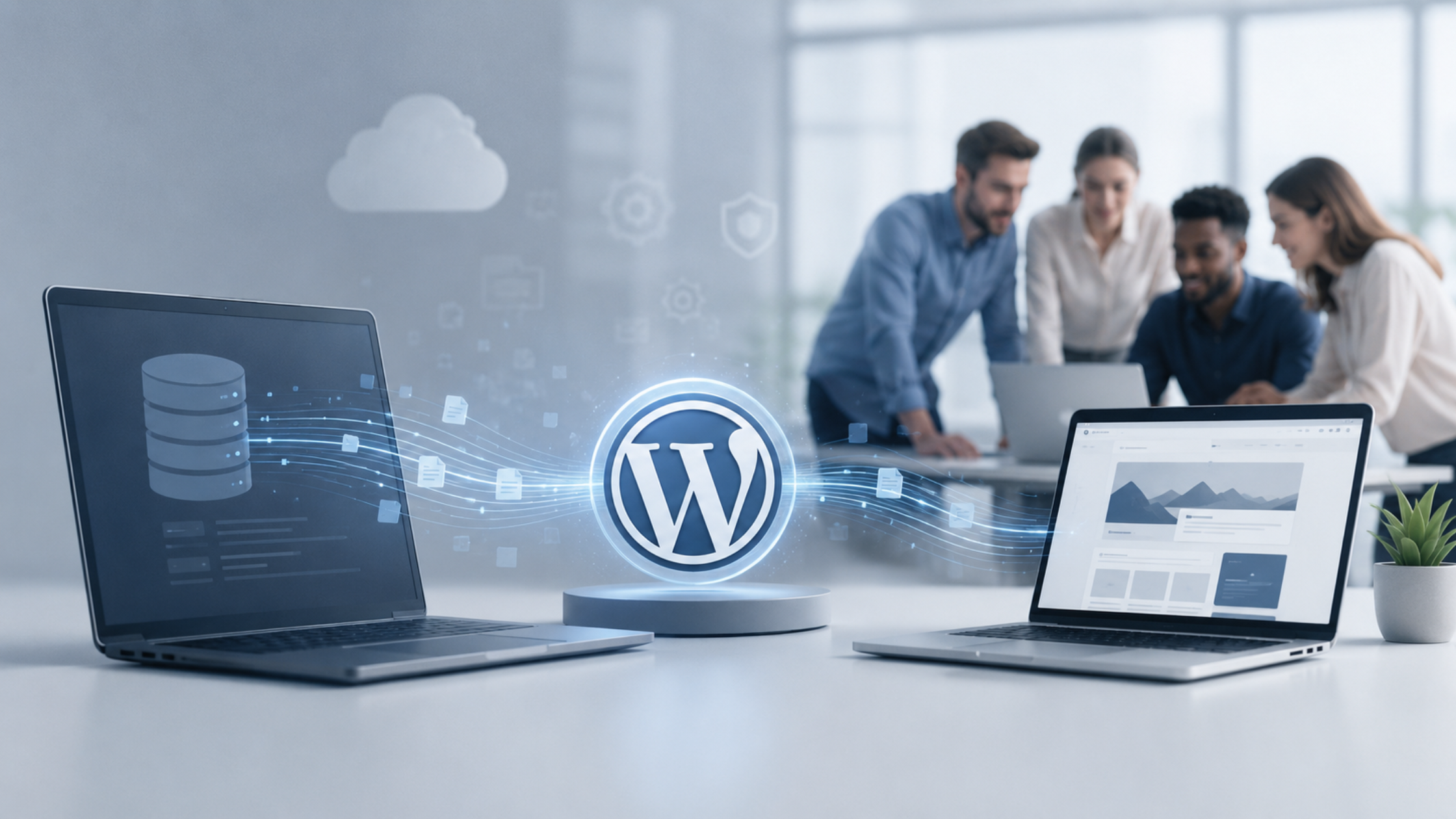
Why WordPress Has Become an Enterprise-Level Solution
WordPress has long been perceived as a blogging tool or as a content management system that is fit for small firms.
Times have changed, however.
Nowadays, companies can utilize WordPress as a flexible and scalable system to run their websites on.
Contemporary WordPress enterprise systems are capable of handling complicated architectures, big content management processes, global traffic, multilingual solutions, security infrastructure, and custom integration.
It means that WordPress development has become an essential service in preparing for digital transformation.
Modern enterprises choose WordPress because it offers:
- Flexible customization
- Strong SEO capabilities
- Scalable architecture
- Faster content management
- Extensive integration support
- Better user experience control
- Cost-effective scalability
Unlike rigid proprietary CMS platforms, WordPress allows businesses to adapt quickly as market requirements evolve.
This flexibility becomes especially valuable during large-scale digital expansion.
Enterprise CMS Migration Requires More Than Data Transfer
Enterprise CMS migration
One of the biggest misconceptions businesses have is believing migration is simply about moving content from one platform to another.
In reality, Enterprise CMS migration is a highly strategic and technically sensitive process.
Migration impacts:
- Website performance
- SEO rankings
- User experience
- Security systems
- Content structure
- Internal workflows
- Third-party integrations
- Mobile responsiveness
Even small migration mistakes can create serious problems such as:
- Traffic loss
- Broken pages
- SEO ranking drops
- Data inconsistencies
- Downtime issues
- Poor user experience
This is why enterprises require structured planning before migration begins.
A successful migration strategy includes:
- Infrastructure analysis
- SEO preservation planning
- Content mapping
- Performance optimization
- Security audits
- Testing environments
- Scalability preparation
Without proper execution, businesses risk disrupting digital operations significantly.
This complexity is why enterprises increasingly depend on dedicated WordPress development teams rather than general development support.
Why Dedicated Teams Improve Migration Success
Migrations on a large scale have more than one aspect to them.
There is the need for certain technology and operation aspects, search engine optimization, performance standards, and business continuity considerations all at once.
A migration is made easy by dedicated teams that can focus only on these interrelated aspects.
Unlike general development resources handling multiple unrelated tasks, specialized teams bring:
- Structured workflows
- Technical expertise
- Migration-specific experience
- Better coordination
- Faster problem-solving
- Long-term scalability planning
Professional teams have knowledge about enterprise systems and know how different migration choices affect business efficiency other than the site itself.
Specialization minimizes risks greatly.
Companies that work together with experts from the WordPress development team usually experience smooth migration due to pre-planning for scalability, security, and efficiency.
SEO Preservation Is One of the Biggest Migration Challenges
Migration poses many challenges for businesses, but perhaps none more crucial than that of maintaining search engine optimization visibility.
Fortunately, this fear is legitimate.
It takes years to develop an effective SEO campaign that yields high results. However, just days can be enough to destroy such work during migration.
This is precisely why maintaining SEO has become a fundamental element in Enterprise CMS migrations today.
Dedicated teams focus heavily on:
- URL structure preservation
- Redirect implementation
- Metadata migration
- Internal linking consistency
- Page speed optimization
- Technical SEO monitoring
Without proper SEO planning, businesses may experience:
- Traffic decline
- Ranking drops
- Indexing issues
- Broken links
- Reduced lead generation
Specialized WordPress development teams help minimize these risks by integrating SEO strategy directly into the migration process.
This ensures that business visibility remains stable while the platform infrastructure improves.
Scalability Is the Real Goal Behind Modern Migration
Many businesses initially migrate because they face operational limitations.
But the long-term goal is usually scalability.
Modern enterprises require systems capable of supporting:
- High traffic growth
- Multi-location operations
- Personalized customer experiences
- Content expansion
- Marketing automation
- Advanced integrations
Complexity is often a big problem for legacy platforms.
That is why scalability is currently one of the key benefits of enterprise-level WordPress ecosystems.
A sound WordPress development approach will not just solve existing issues, but it will also be aimed at making sure that businesses can grow in the future.
Scalability ensures that bottlenecks are minimized and businesses have more flexibility when adapting to market changes.
For enterprises, migration does not mean modernization alone – it means achieving digital flexibility.
User Experience Plays a Major Role in Migration Strategy
Modern-day digital experiences impact consumer trust.
When websites appear sluggish, cluttered, outdated, and complicated, consumers abandon them immediately irrespective of the strength of the company.
Therefore, user experience becomes one of the top priorities when migrating.
Dedicated WordPress development teams focus heavily on improving:
- Website speed
- Mobile responsiveness
- Navigation flow
- Content accessibility
- Conversion optimization
- Performance consistency
Migration creates an opportunity not only to modernize infrastructure but also to improve how users interact with the platform.
This directly impacts:
- Engagement rates
- Customer retention
- Lead generation
- Brand credibility
Enterprises increasingly recognize that user experience is no longer separate from business growth.
It is deeply connected to digital performance.
Security and Compliance Are Becoming More Important
Enterprise platforms manage large amounts of sensitive data.
As businesses scale, security expectations become significantly higher.
Modern enterprises must ensure:
- Secure infrastructure
- Data protection compliance
- Access control management
- Threat monitoring
- Secure integrations
Outdated CMS systems often create vulnerabilities because they lack modern security architecture or scalable update frameworks.
This is another major reason businesses pursue Enterprise CMS migration initiatives.
Dedicated WordPress development teams help enterprises implement:
- Advanced security protocols
- Role-based access systems
- Secure hosting environments
- Regular maintenance workflows
- Compliance-focused structures
Security is no longer treated as an optional technical feature.
It has become a critical business requirement directly connected to customer trust and operational stability.
Why Migration Without Strategy Often Fails
Many migration projects fail not because the technology is weak, but because the strategy behind the migration is incomplete.
Businesses sometimes focus only on launching quickly while ignoring:
- Infrastructure planning
- Performance testing
- SEO preservation
- Scalability preparation
- Workflow optimization
This creates long-term operational issues after migration is completed.
Successful enterprise migrations require alignment between:
- Business goals
- Technical execution
- Marketing requirements
- Customer experience expectations
Dedicated WordPress development teams help create this alignment because they understand how technical decisions impact broader business operations.
Migration success is not measured only by whether the website launches successfully.
It is measured by how effectively the platform supports future business growth.
How Diginnovators Helps Enterprises Modernize Successfully
At Diginnovators, we understand that enterprise migration is not simply a technical process.
It is a strategic transformation project connected to scalability, performance, customer engagement, and long-term business growth.
Our team helps businesses through:
- Enterprise migration planning
- Scalable WordPress architecture
- SEO-focused migration strategies
- UX/UI optimization
- Security implementation
- Performance optimization
- Ongoing support and scalability planning
We focus on building enterprise-ready systems designed for flexibility, operational efficiency, and sustainable digital growth.
Whether businesses are migrating from legacy CMS platforms or modernizing large-scale content ecosystems, our goal is to create systems that improve both performance and long-term scalability.
The Future of Enterprise CMS Ecosystems
The future of enterprise digital infrastructure will focus heavily on flexibility, scalability, automation, and personalized user experiences.
Businesses will increasingly require platforms capable of adapting quickly to:
- Market changes
- Customer expectations
- Technology advancements
- Content expansion
- Global scalability
This is why enterprise-level WordPress ecosystems are becoming more important across industries.
Businesses are no longer searching only for content management systems.
They are searching for scalable digital ecosystems capable of supporting long-term innovation and growth.
Conclusion
In today’s world, companies cannot depend on their obsolete CMS solutions, restricting scalability and performance.
With constantly evolving digital experiences, companies are increasingly acknowledging the significance of implementing successful Enterprise CMS migration strategies to ensure sustainable operations in the future.
Migration does not merely involve technical work, but also involves planning, SEO migration, scalability preparation, security enhancement, and improvements in user experience at the same time.
This is where our expertise as a WordPress development agency comes into play.
We enable your company to develop a scalable ecosystem based on WordPress and its powerful performance and security capabilities.
Since in today’s world migration is about laying the foundation for business growth in the futur